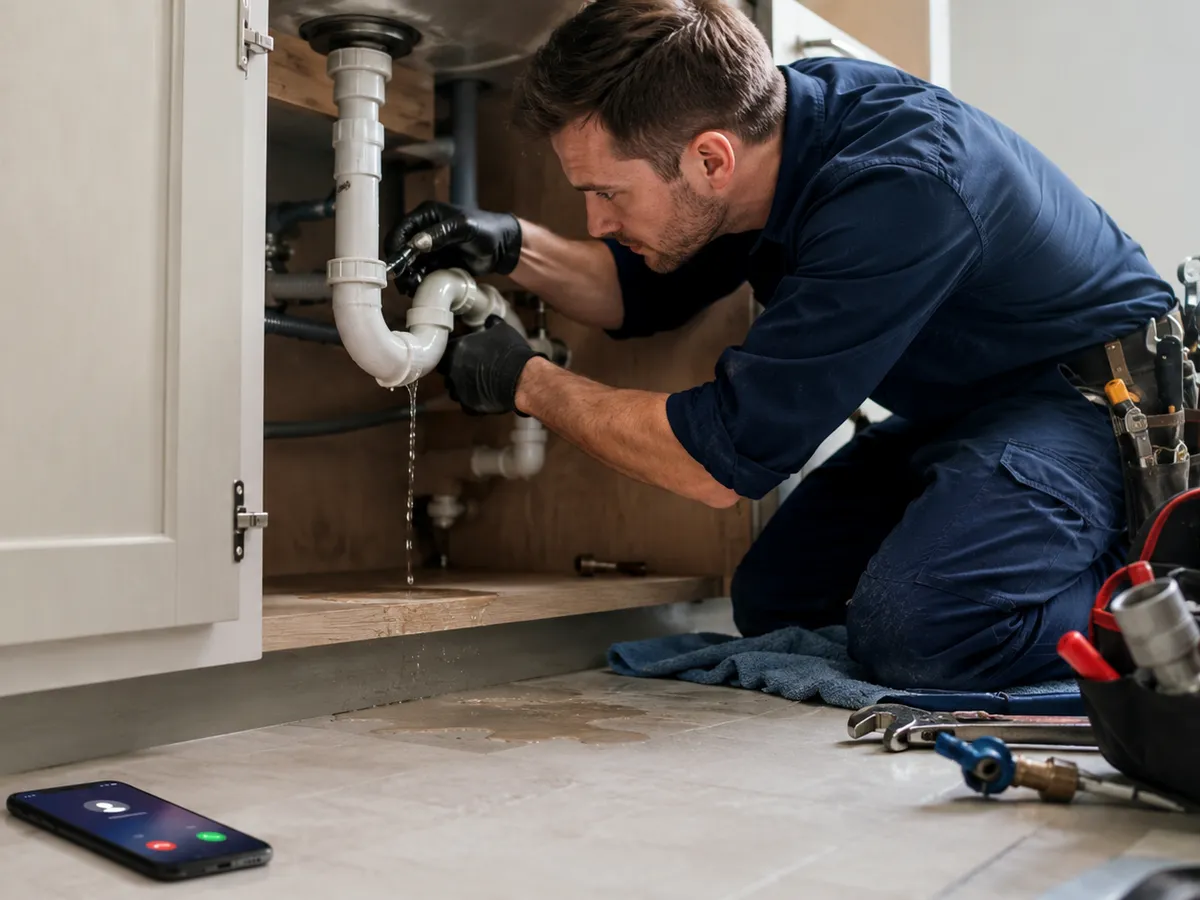
If a homeowner calls at 8 p.m. with water running down a wall and gets voicemail, that call is not waiting for you. The homeowner will dial the next company on the list within minutes. For an owner, a missed after-hours call is usually a lost job, and the loss shows up later as a slow week nobody can explain.
This guide explains why calls go unanswered after hours and what the callers want. It gives a formula for pricing the loss with your own numbers, then compares ways to cover the phone. It ends with questions to ask before you pick a 24/7 call answering service.
Why do service businesses miss calls after hours?
Service businesses miss calls after hours because the people who could answer are busy, off the clock or on another call, and the phone usually has one place to ring. The cause is rarely carelessness. It is how a small trade company is staffed.
Five situations account for most of it:
- The owner is on a job, with hands in a panel or under a sink, and can’t pick up.
- The office closes at 5 p.m., and the dispatcher or office manager goes home.
- The business has one phone number, and it rings in one place at a time.
- The call rolls to voicemail, and the caller hangs up before the beep.
- The owner is asleep, at dinner or at a kid’s game, which is a fair reason to be unreachable.
None of the five is a failure of effort. A company with $1 million to $10 million in revenue has real work during the day, and a full overnight shift for the phone would cost more than most owners will pay. The phone still keeps ringing, though.
CallRail’s analysis of 1.1 million leads, released in January 2025, found home services businesses missed 14% of calls. That is an average across all hours of the day. The data does not separate after-hours calls, so treat it as a sign that misses are common, not as an after-hours rate. Your own phone records will tell you more than any average.
What is an after-hours call usually about?
An after-hours call is usually either an emergency or a request for an appointment, and both are time-sensitive. Few after-hours callers are casually browsing. Something broke, or the caller finally has time to book.
Emergencies are common. In a HomeServe USA survey fielded in August 2025, with 2,524 US adults (2,333 of them homeowners), more than 8 in 10 reported a home repair emergency in the past year. The most common were heating or cooling failure at 30%, appliance breakdown at 29% and a clogged or overflowing toilet at 26%. Heating, cooling and plumbing failures are the calls HVAC and plumbing companies take. The survey does not say what time of day the emergencies happened, but most owners know the answer from their own call logs.
The other group is the planner: the homeowner who works all day and calls at 7:30 p.m. to book a tune-up, an estimate or a panel inspection. This caller isn’t in a crisis, but also isn’t going to call back at 9 a.m. from a desk. A caller who gets no answer will usually try another number.
The two types need different handling. An emergency should reach a person fast. An appointment request needs an open slot and a confirmation, which doesn’t need anyone awake.
Is a Saturday voicemail a missed call or a missed job?
A Saturday voicemail is a missed job, because the caller will most likely phone another company before Monday. There is no verified number behind that, so treat it as operating logic and not a statistic. The logic is simple, though.
Someone who calls a heating contractor on Saturday has a problem or a plan, and neither one waits for your office to open. Voicemail asks the caller to hold that problem for up to two days on the hope that you call back first. The next company on the search results page asks nothing of the caller. If that company picks up, it gets the job, and your Monday callback reaches someone whose problem is already solved.
Some voicemail callbacks do turn into jobs, and some loyal customers will wait. But a new caller has no loyalty to you yet. Your call-log history is the best check: look at how many weekend voicemails you returned and how many became booked work.
How much does an unanswered after-hours call cost you?
An unanswered after-hours call costs you the profit on the job the caller would have booked. You can estimate this monthly with four numbers from your own business, and the answer comes out in dollars you can compare against any service quote.
The formula:
Missed after-hours calls per month × share that were real jobs × share you would have booked × average job value = job value lost per month
Here is how to find each input:
| Input | Where to find it |
|---|---|
| Missed after-hours calls per month | Your phone carrier’s call log for evenings, nights and weekends, plus voicemails |
| Share that were real jobs | Listen to a month of voicemails and mark the real requests; skip wrong numbers and sales calls |
| Share you would have booked | Use your close rate on daytime inbound calls as a starting guess |
| Average job value | Your invoiced revenue divided by jobs completed, by trade |
To show the arithmetic only, suppose a company logs 20 missed after-hours calls a month, 60% were real jobs, it would have booked half of those, and the average job is $400. That is 20 × 0.6 × 0.5 × $400, or $2,400 a month. Those inputs are made up for the example. Replace every one of them with yours.
Two cautions keep the number honest. First, use average job value, not your best-case emergency repair. Second, remember that a booked visit is not the same as collected revenue, so subtract your normal cost of doing the job if you want profit.
Four ways to cover the phone after hours
You have four realistic options: your own cell phone, a live answering service, an AI receptionist, or an AI setup that books jobs and passes emergencies to a person. Each one handles the call differently, and the right one depends on your volume and how you want emergencies handled. For the AI-versus-human comparison in depth, see AI Answering Service vs Human Answering Service.
Your own cell phone. Forward the business line to your mobile. It costs nothing extra and the caller reaches the person who can fix the problem. It also means you take every call, at every hour, including the ones that could wait. It fails when you are on a roof, asleep or on another call.
A live answering service. Trained receptionists answer in your company’s name and pass along a message or a transfer. The caller gets a person. Depending on the plan, the receptionist may only take a message, which you still have to return. Billing is often by the minute.
An AI receptionist or AI answering service. A voice assistant answers every call, any hour, and can take several at once. Whether it books anything depends on whether it is connected to your calendar. One that only takes a message is voicemail with better manners.
Go-BOSS. Go-BOSS answers calls 24/7 with an AI receptionist, handles the caller’s question, books the appointment and sends the full transcript. The solutions page also describes a text-back for every missed call, and calls, texts, emails and web chat landing in one shared inbox. Setup is guided and mirrors your current lead and sales process, which is where you decide which calls count as emergencies and who gets them. It is meant to answer and book, and to hand urgent calls to a person you name. It does not replace dispatch or routing software.
What should you ask before choosing a 24/7 answering service?
Ask five things, and ask for a demonstration of each, not a description: what it books, how it handles emergencies, what record it writes, who sees that record the next morning, and what the bill looks like in your busiest month. The answers show how the call ends, which matters more than how it starts.
- What does it book? Ask the provider to book a real appointment on a test calendar while you watch. If it can only take a message, price it as a message service.
- How does it escalate an emergency? Ask what triggers an escalation, who is called, in what order, and what happens if that person doesn’t answer. Make a test call describing a gas smell or a flooded basement and time the result.
- What record does it write? You want the caller’s name, number, address, the problem, the urgency and what the service did. A recording alone is not enough, since someone has to listen to it.
- Who sees it next morning? Find out where the record lands and who is told. A text to the owner at 6 a.m. is different from an entry in a shared inbox the office checks at 8.
- How does billing work in a busy week? Ask for a sample bill with your own call count, since a storm or a cold snap can double your volume.
Also ask what the service does when it doesn’t know the answer. A good one passes the call to a person with the details already collected, so the caller doesn’t start over.
Next step: put a number on your own phone
Pull last month’s call log, mark the after-hours calls nobody answered, and run the formula. That one figure tells you how much a service could be worth to you before you talk to a single vendor.
If you want a wider picture, the 3-minute Operational Health Checklist asks how quickly you respond to new calls, where admin time goes and which tools don’t share information. It helps you see whether missed calls are your biggest problem or one of several.